Launch offer — valid today only

📄 Digital book in PDF · read it on your phone or print it

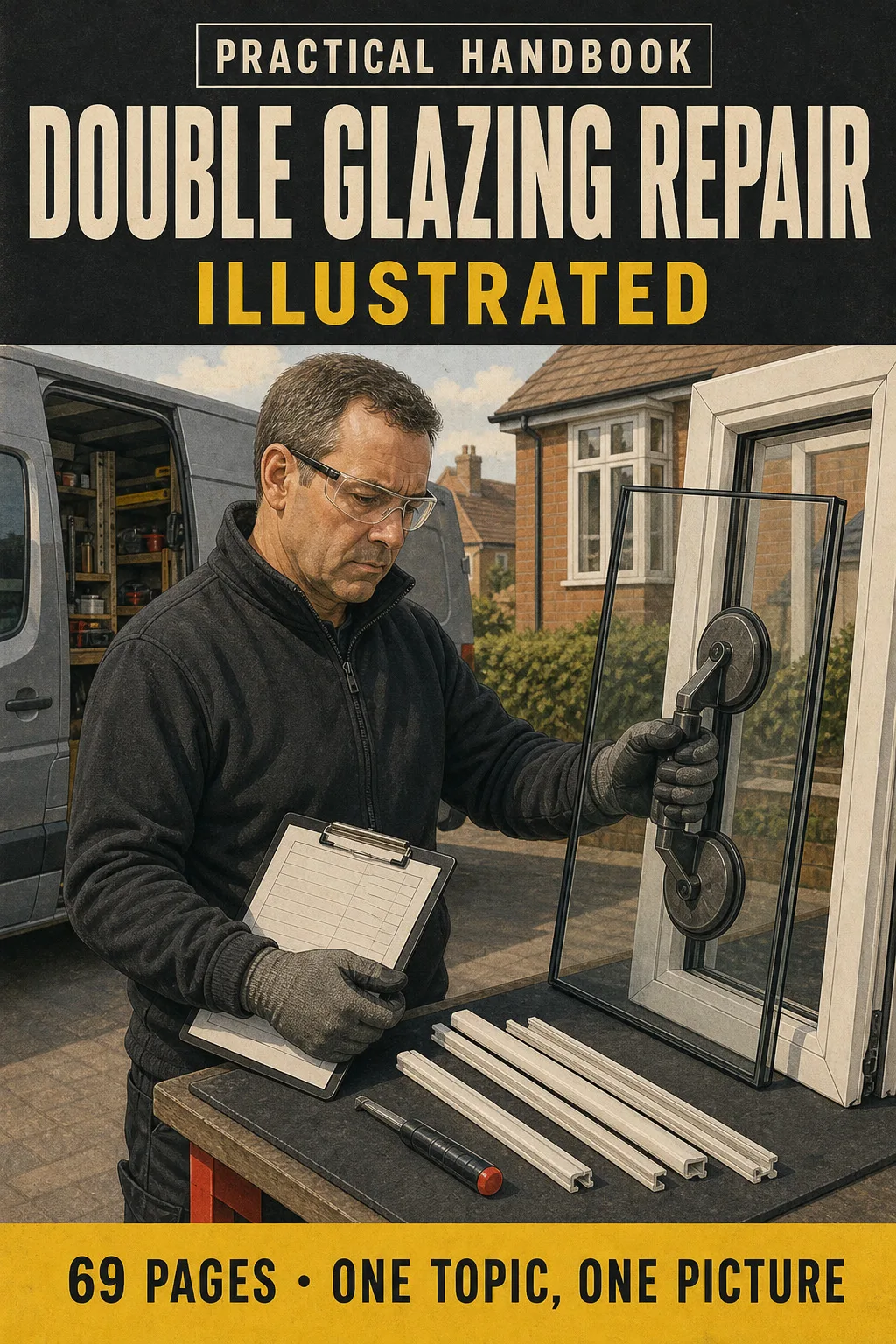
UK Double Glazing Repair in Drawings Measure, Order and Refit a Sealed Unit, Step by Step

Sealed units, measuring and ordering, beads and gaskets, setting blocks and packers, timber and aluminium frames, friction stays, espag handles and safety glazing. Each topic has its own page: the drawing first, then what you need to remember. 69 illustrated pages.

SEE IT ALL DRAWN

🔒 Secure checkout · PDF by email · 30-day guarantee

Every topic, its own pageEvery repair drawn, with the steps beside it
69 illustrated pages9 parts, from reading the window in front of you to the on-the-job checks
Up-to-date sourcesChecked against Approved Documents K, F, B and L, BS 6262 and BS EN 1279
PDF by emailFormat

Look Inside the Book

Every page has one big drawing and a box with the measurements and steps you need on the job:

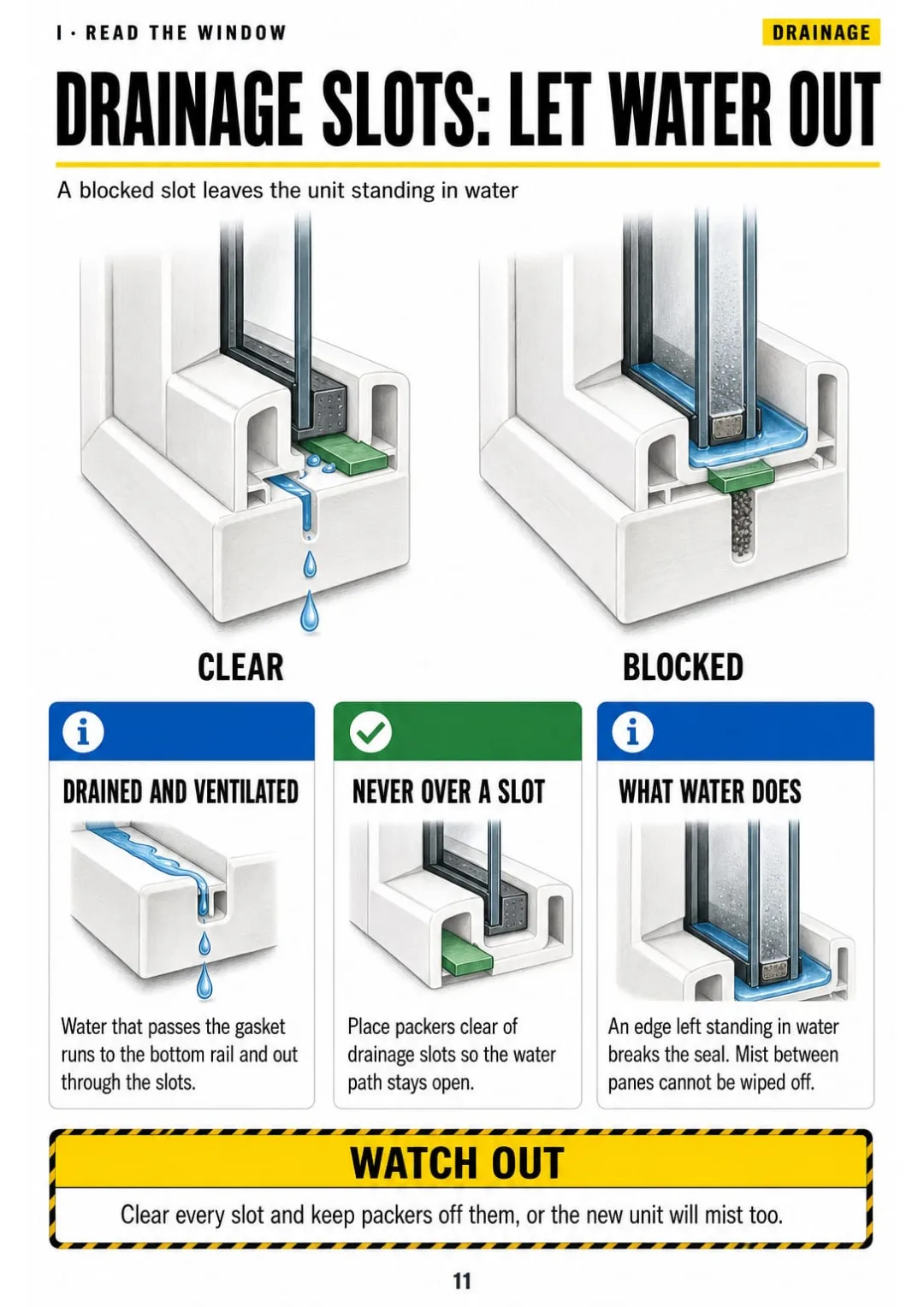
Where drainage slots are, and why a packer over one fails the edge seal.
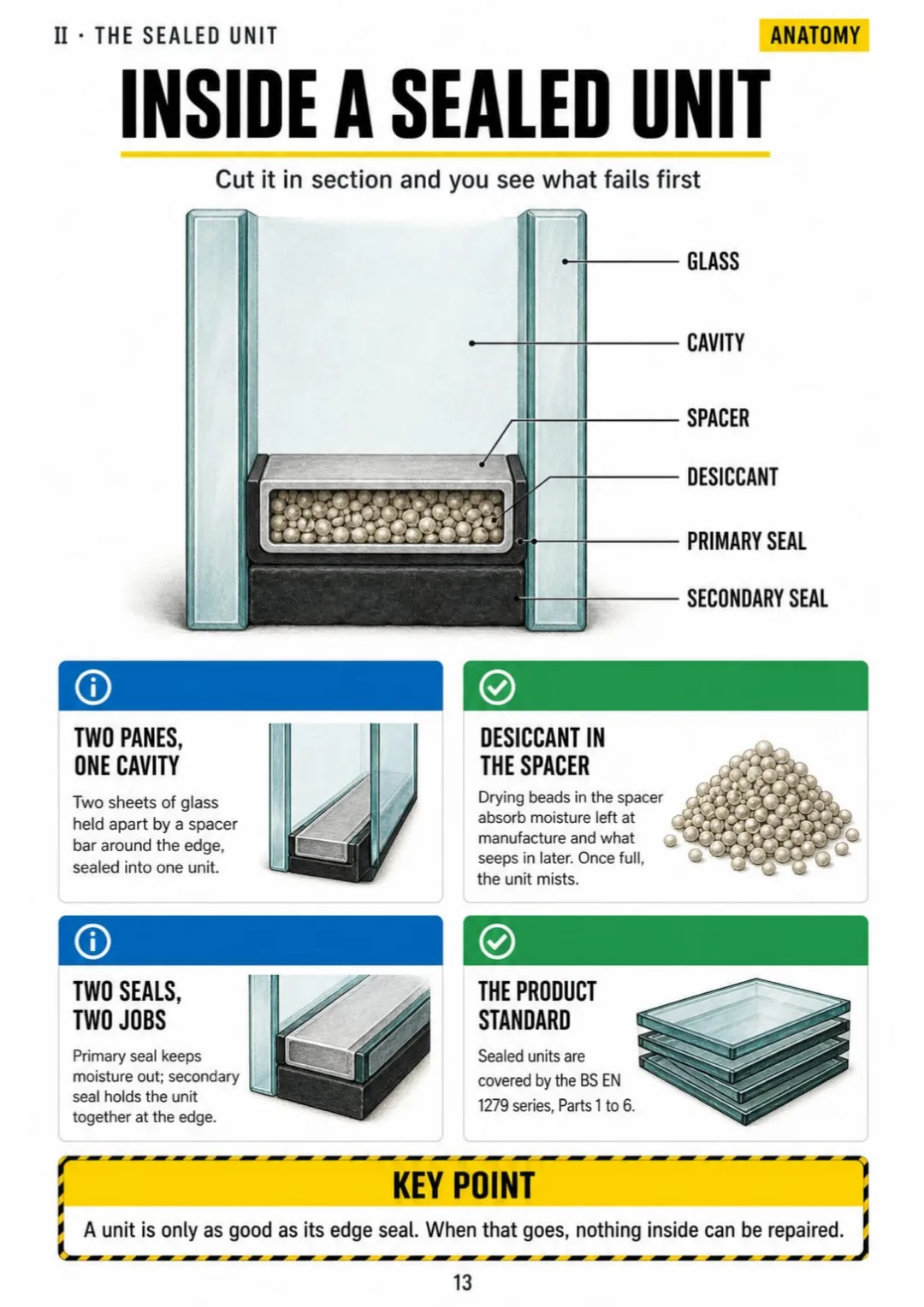
Two panes, spacer, desiccant, primary and secondary seal: the sealed unit drawn in section.
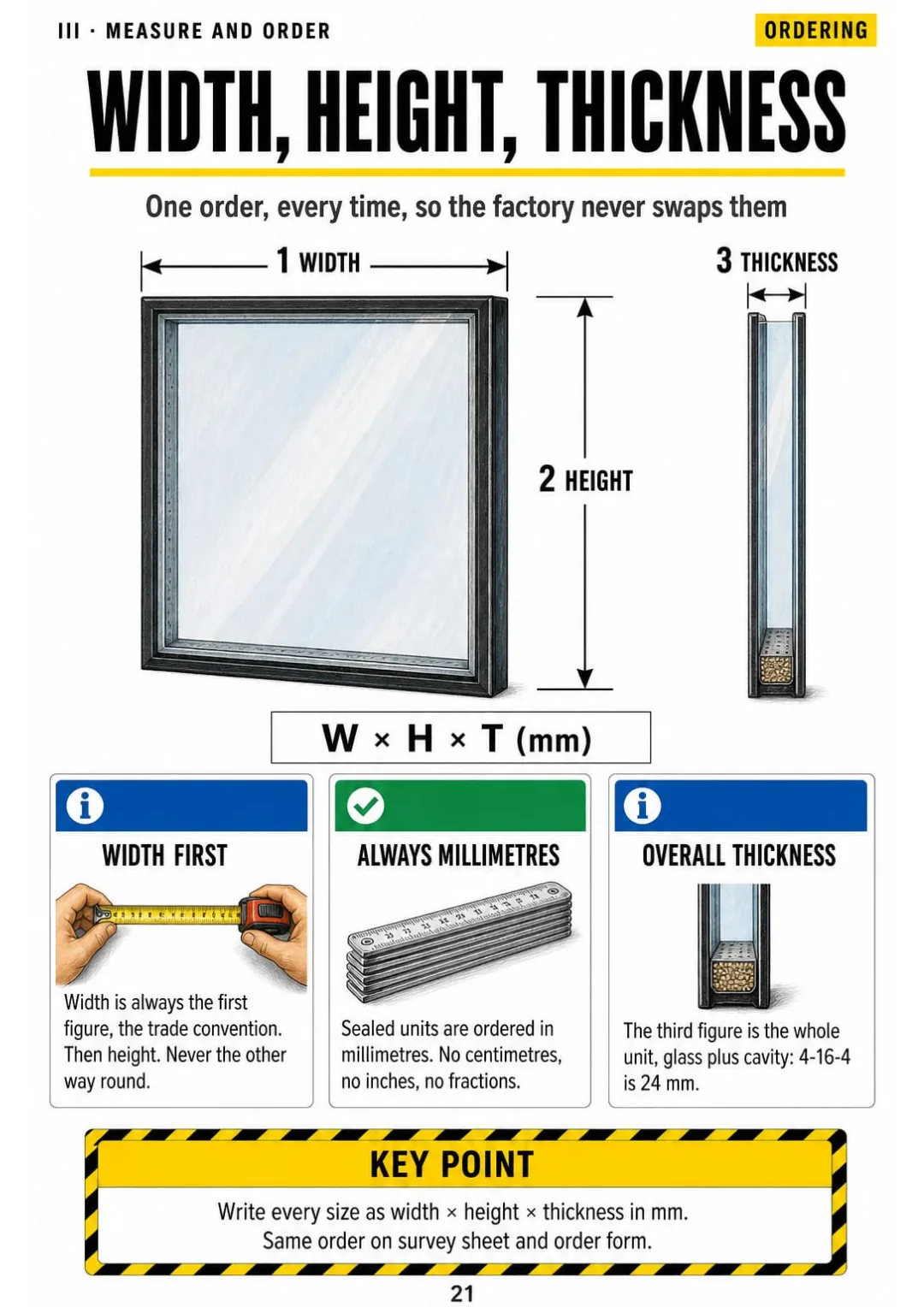
Every unit ordered as width × height × overall thickness, in millimetres
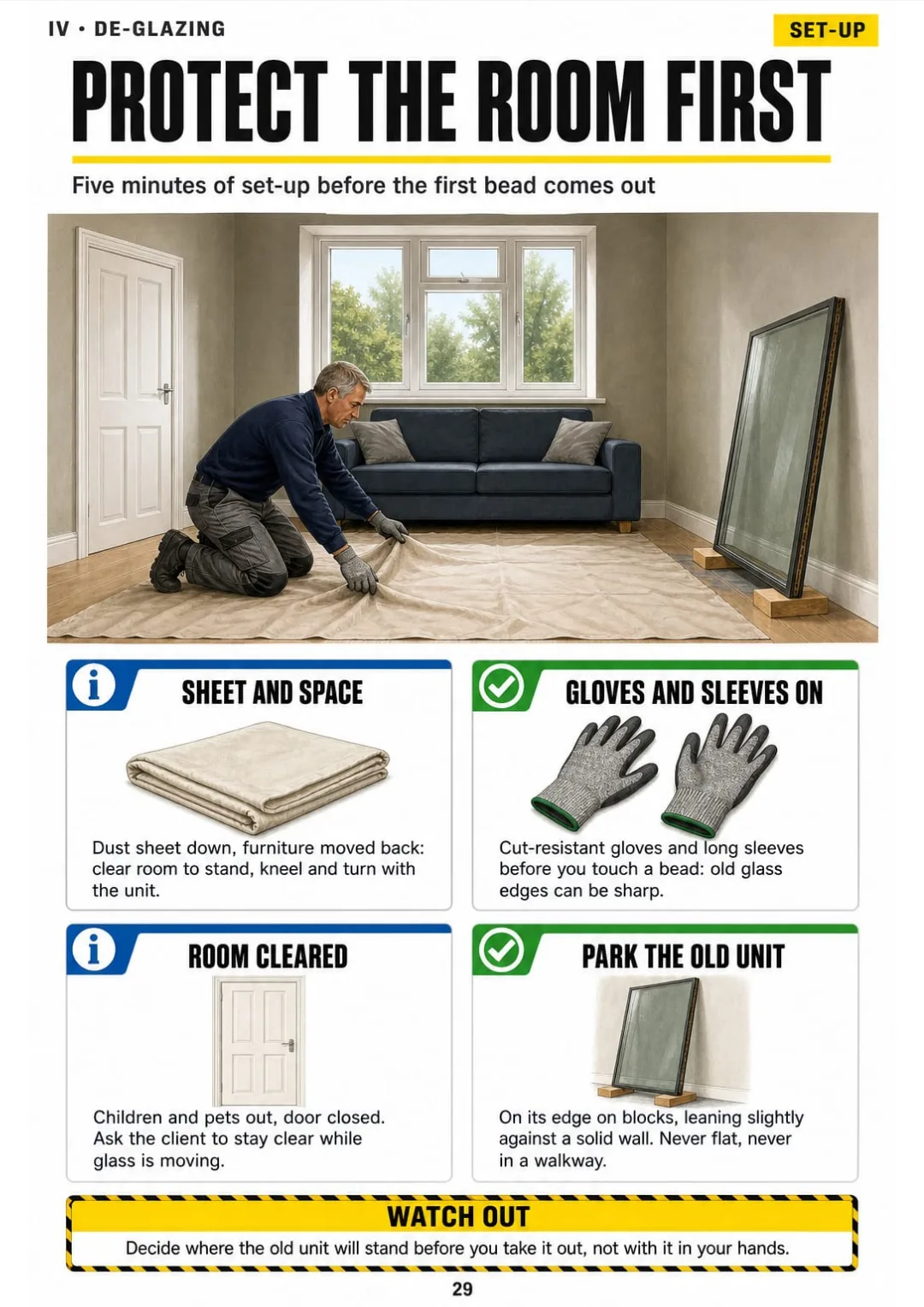
Dust sheet, gloves, room cleared and the old unit parked upright against a wall
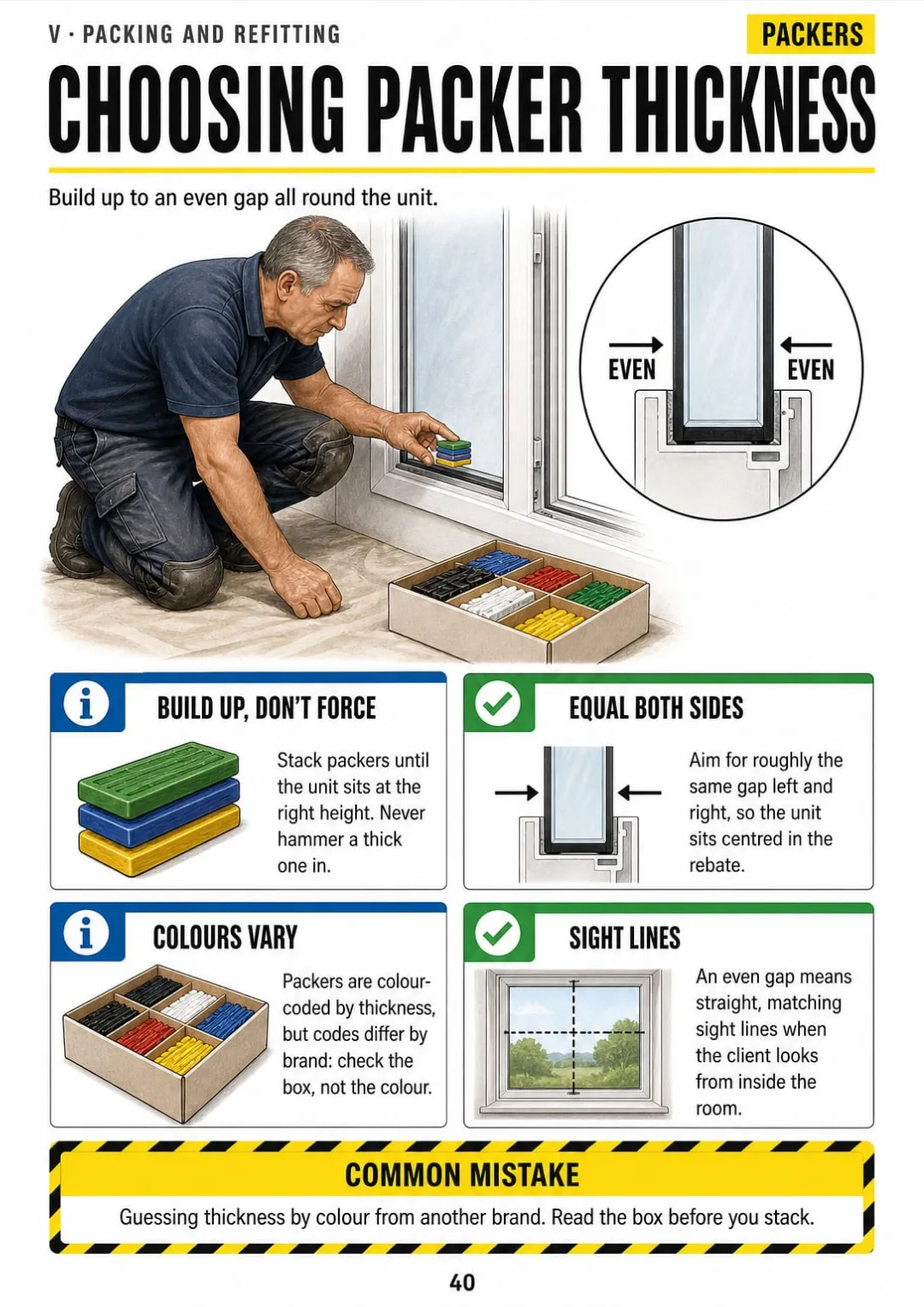
Packer thickness: build up to an even gap all round, roughly equal on both sides.
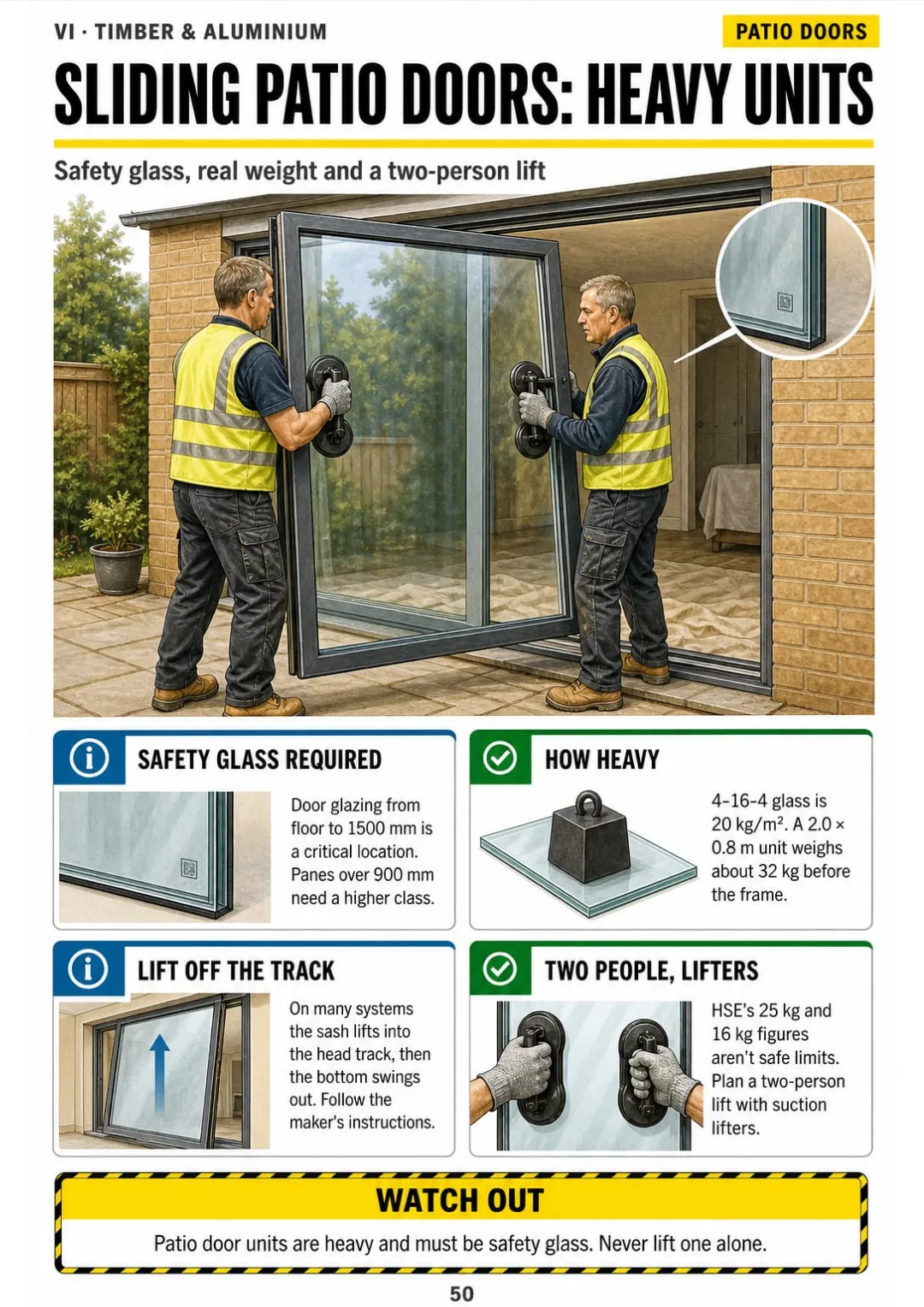
Sliding patio doors: toughened safety glass, about 32 kg per unit, and when to use two people and lifters
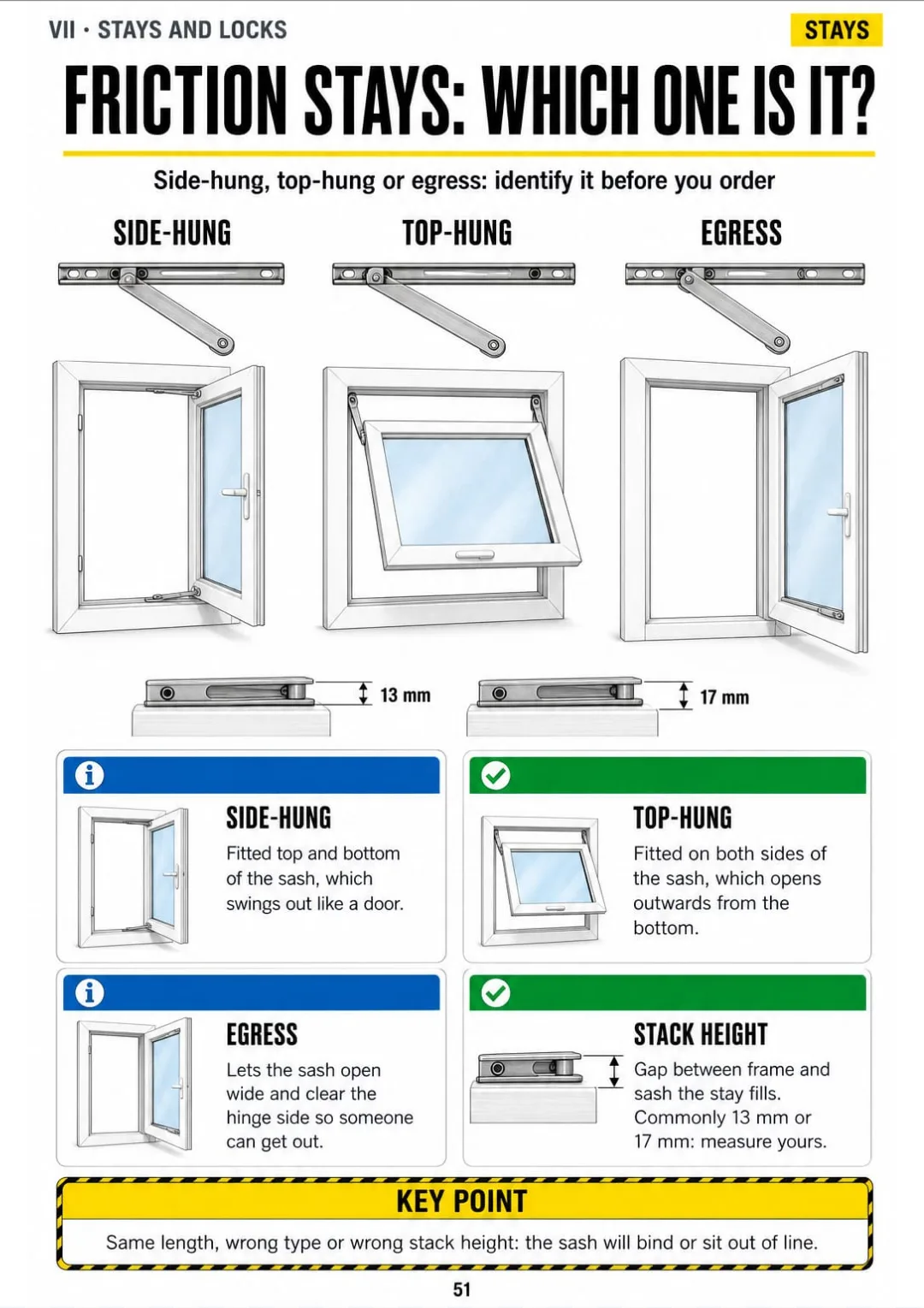
Side-hung, top-hung and egress stays drawn side by side, with 13 or 17 mm stack height
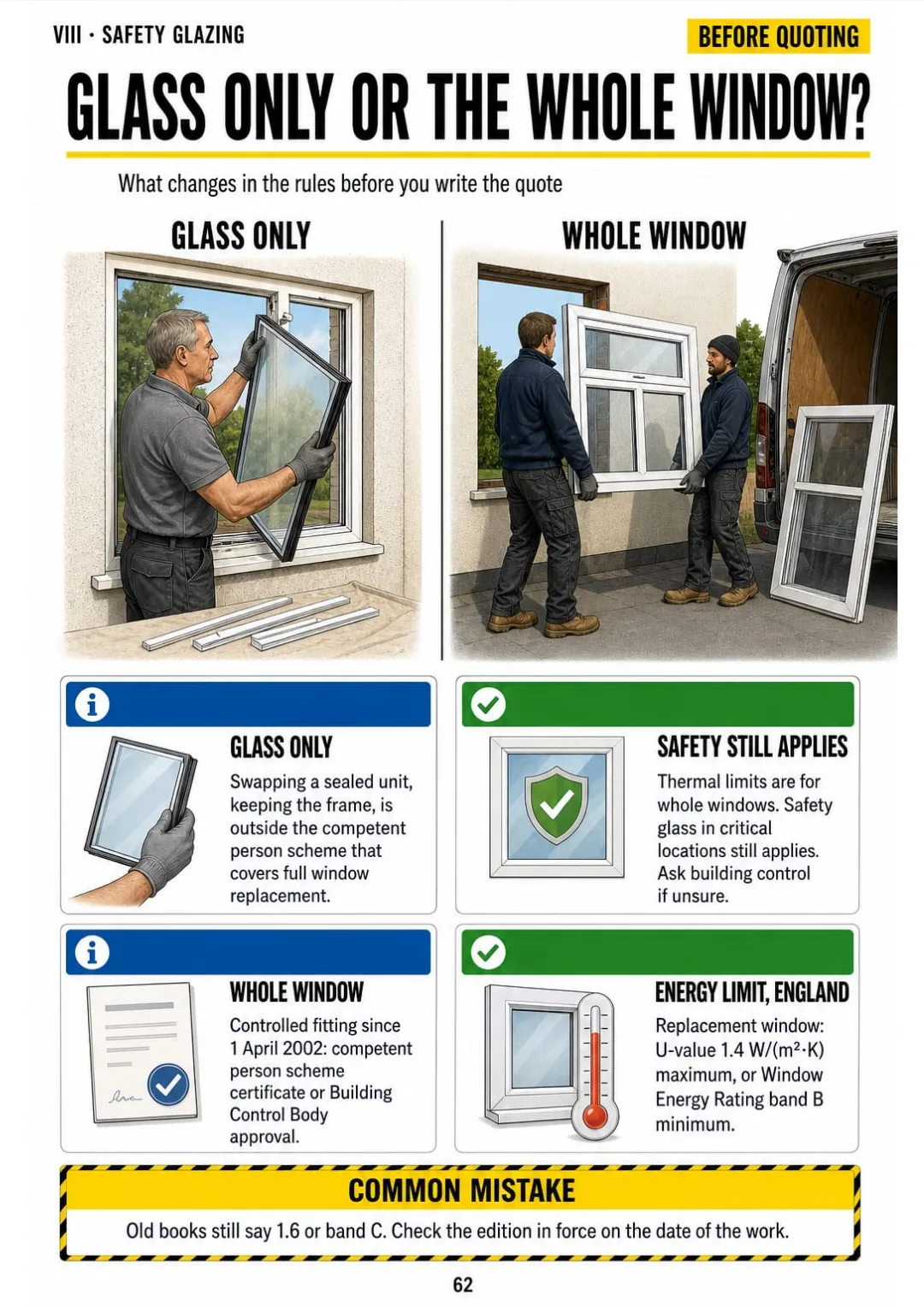
Whole window in England: 1.4 W/(m²·K) or band B, plus certificate. Glass only: safety rules still apply.

Swipe to see more →

These are real pages from the book. The table of contents is the full one: 9 parts and 65 topics.

The Problem Isn't You. It's How It Was Explained.

You're at a misted bedroom window with a tape in your hand and an order form to fill in. Width, height, thickness: and you're not sure which figure goes where.

The manual covers it in a paragraph about rebates, tolerances and overall thickness. You read it in the van, and by the time you're at the window the words have gone and the doubt is still there.

Every unit ordered as width × height × overall thickness, in millimetres

In this book it's one page. The unit is drawn with three arrows: width × height × overall thickness, all in millimetres, and what you take off the rebate size for edge clearance, in the sequence the order form asks for them.

It's the same with the rest of the job: which bead comes out first, where the setting blocks sit, how to read a toughened glass mark, which friction stay you've got. Each one has its own page.

So you measure once, order the right unit and fit it without going back to the manual, or back to the job the next day.

COMPARE FOR YOURSELF

The Same Topic, Two Ways to Learn It

THIS
  • The manual: line after line
  • Sealed units explained only in words
  • You get to the job still unsure
An insulating glass unit comprises two or more panes of glass separated by a perimeter spacer, typically of aluminium or a composite warm-edge material, which contains a hygroscopic desiccant intended to absorb residual moisture within the cavity. The assembly is bonded by a primary seal, generally polyisobutylene, applied between the spacer and the glass, and by a secondary seal of polysulphide, polyurethane or silicone, which provides structural adhesion. Failure of either seal permits vapour ingress, resulting in internal condensation between the panes.
FOR THIS
  • The sealed unit in one drawing
  • Panes, spacer, desiccant and seals in a box
  • You see it and you get it
Two panes, spacer, desiccant, primary and secondary seal: the sealed unit drawn in section.
CONTENTS

Take a Look at the 9 Parts and 65 Topics

Reading the window, the sealed unit, measuring and ordering, de-glazing, packing and refitting, timber and aluminium frames, stays and locks, safety glazing and on-the-job checks: 69 pages, all illustrated.

IRead the Window in Front of You · pp. 5-12
  1. The window from the front and in section
  2. uPVC, timber or aluminium: tell them apart in 10 seconds
  3. Internally or externally beaded?
  4. Casement, tilt and turn, fixed light, sliding sash
  5. Rebate, sight line and glazing platform
  6. Bead and gasket types
  7. Drainage slots and why water must get out
  8. The tool roll for glass work
IIThe Sealed Unit · pp. 13-20
  1. Anatomy of a sealed unit
  2. Why units mist: seal failure, not condensation
  3. Reading the build-up: 4-16-4, 4-20-4
  4. Spacer bars: aluminium or warm edge
  5. Low-E glass and which face the coating goes on
  6. Toughened and laminated: how to read the mark
  7. Obscure, Georgian bar and leaded units
  8. How heavy is the unit you are lifting?
IIIMeasure and Order Right First Time · pp. 21-28
  1. The three measurements: width, height, thickness
  2. Measuring the old unit once it is out
  3. Measuring with the unit still in: rebate to rebate
  4. Checking thickness without taking it out
  5. Out-of-square frames: read the diagonals
  6. Shaped units: arches, rakes and templates
  7. Filling in the sealed unit order form
  8. Label every unit before you leave the job
IVDe-glazing Without Breaking Anything · pp. 29-35
  1. Before you start: protect the room and the client
  2. uPVC beads: which one comes out first
  3. Bead knife, not screwdriver
  4. Numbering beads so they go back where they came from
  5. Lifting the unit out of the rebate
  6. Note the old packers before you lose them
  7. Clean the rebate and clear the drainage
VPacking and Refitting the Unit · pp. 36-44
  1. Setting blocks: where they sit and why
  2. Location packers: sides and top
  3. Toe and heel: packing that keeps a sash square
  4. Packing a fixed light versus an opening sash
  5. Choosing packer thickness
  6. Setting the unit the right way round
  7. Re-beading: short beads first, long beads last
  8. Gaskets: refit or replace
  9. Final checks before you call the job done
VITimber and Aluminium Frames · pp. 45-50
  1. Timber beaded frames: pins, screws and sealant
  2. Putty-glazed timber and sealed units
  3. Timber rebates: rot, depth and making good
  4. Aluminium frames: wedge gaskets and clip beads
  5. Aluminium drainage and thermal breaks
  6. Sliding patio doors: heavy units, different rules
VIIStays, Handles, Locks and Dropped Sashes · pp. 51-59
  1. Friction stays: identify the type
  2. Measuring a friction stay the right way
  3. Egress stays and escape windows
  4. Swapping a stay without the sash dropping
  5. Espagnolette handles: inline or offset, and spindle length
  6. The espag gearbox and keeps
  7. Multi-point locks: how they work
  8. Dropped sash: diagnose before you adjust
  9. Correcting a dropped sash
VIIISafety Glazing and the Rules to Check · pp. 60-64
  1. Critical locations: where safety glass is required
  2. Side panels next to doors
  3. Replacing glass only versus replacing the window
  4. Ventilation and trickle vents
  5. Wales, Scotland and Northern Ireland
IXOn the Job: Checks and Common Mistakes · pp. 65-69
  1. The whole job on one page
  2. Most frequent measuring mistakes
  3. Most frequent glazing mistakes
  4. Quick fault finder
  5. Pre-start checklist

One Page, One Topic, All Clear

Think of it this way:

You've got the bead off a casement and the new unit in your hands. The client is watching. You need to know where the setting blocks go before the glass touches the frame.

You open the page on setting blocks and there it is, drawn: blocks in from the corners, clear of the drainage slots, never under the middle, with the sash shown from the front and in section.

Packer thickness: build up to an even gap all round, roughly equal on both sides.

The same goes for the bead order, gasket corners, friction stay sizes, dropped sashes and where safety glass is required: each one on its own page.

Double Glazing Repair Illustrated is 9 parts and 65 topics, all drawn, and it finishes with the whole job on one page, a quick fault finder and a pre-start checklist.

What you see drawn, you don't have to memorize.

What's Inside Double Glazing Repair Illustrated:

Ipp. 5-12

Read the Window in Front of You

The window from the front and in section, uPVC, timber or aluminium, internal or external beads, window types, rebates, gaskets, drainage and the tool roll.

IIpp. 13-20

The Sealed Unit

How a sealed unit is built, why it mists, reading 4-16-4, spacer bars, Low-E faces, toughened and laminated marks, and how heavy the unit is.

IIIpp. 21-28

Measure and Order Right First Time

Width, height and thickness, measuring with the unit in or out, out-of-square frames, shaped units, the order form and labelling every unit.

IVpp. 29-35

De-glazing Without Breaking Anything

Protecting the room and the client, which uPVC bead comes out first, the bead knife, numbering beads, lifting the unit and cleaning the rebate.

Vpp. 36-44

Packing and Refitting the Unit

Setting blocks, location packers, toe and heel, fixed lights versus sashes, packer thickness, the unit the right way round, re-beading and gaskets.

VIpp. 45-50

Timber and Aluminium Frames

Timber beads, putty-glazed frames, rotten rebates, aluminium wedge gaskets and clip beads, thermal breaks and heavy patio door units.

VIIpp. 51-59

Stays, Handles, Locks and Dropped Sashes

Friction stays and how to measure them, egress stays, swapping a stay, espag handles and gearboxes, multi-point locks and dropped sashes.

VIIIpp. 60-64

Safety Glazing and the Rules to Check

Critical locations for safety glass, side panels by doors, glass-only versus whole-window jobs, trickle vents, and the rules in Wales, Scotland and Northern Ireland.

IXpp. 65-69

On the Job: Checks and Common Mistakes

The whole job on one page, the most frequent measuring and glazing mistakes, a quick fault finder and a pre-start checklist.

At the end of the book: The whole job on one page, a quick fault finder and a pre-start checklist.
Plus: 2 Free Books

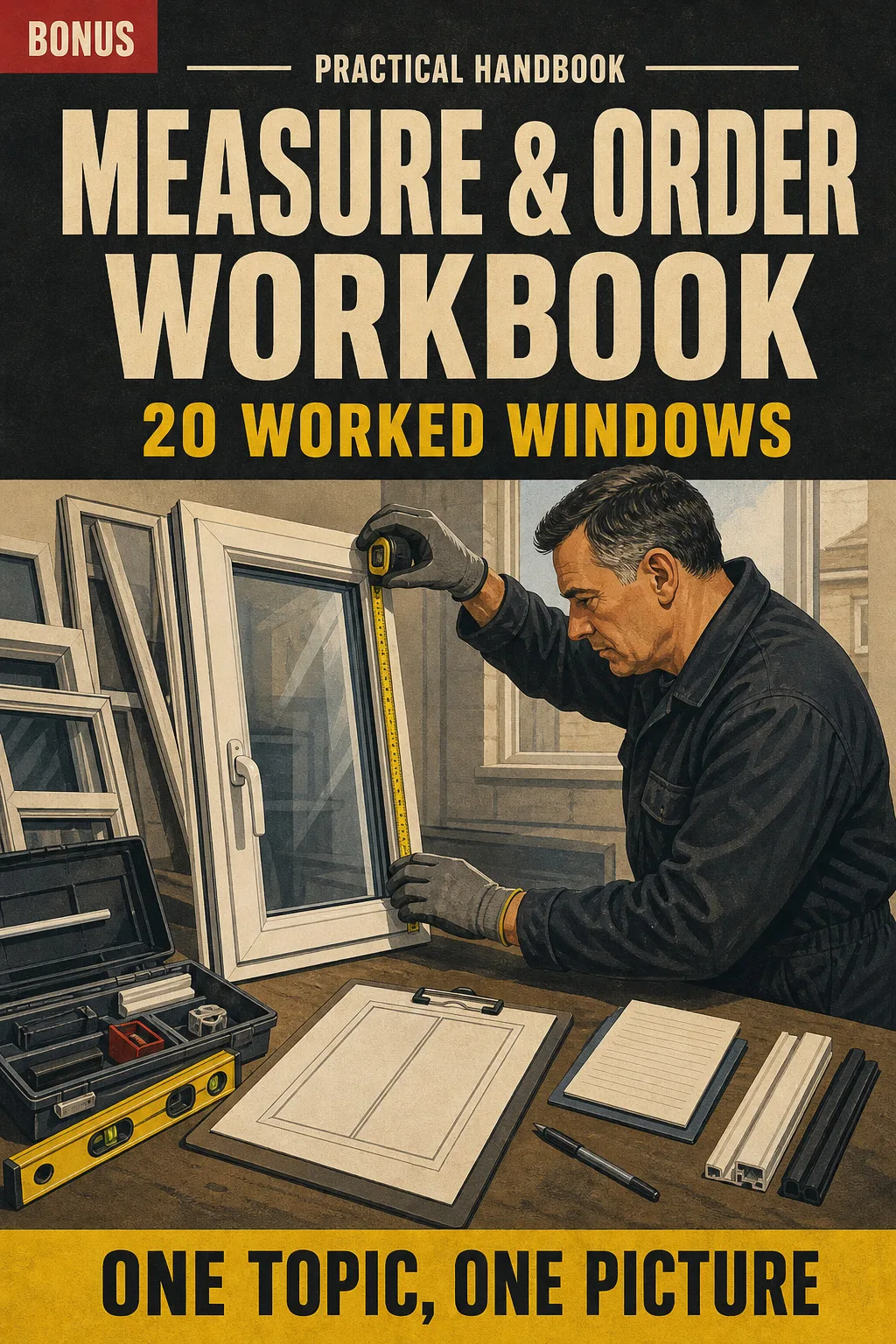
Measure & Order Workbook: 20 Worked Windows

BONUS 1: «Measure & Order Workbook: 20 Worked Windows»

Value on its own: US$ 17.90

Practise measuring width, height and thickness on 20 drawn windows, then fill in the order form yourself, so you get the sealed unit right before you order it.

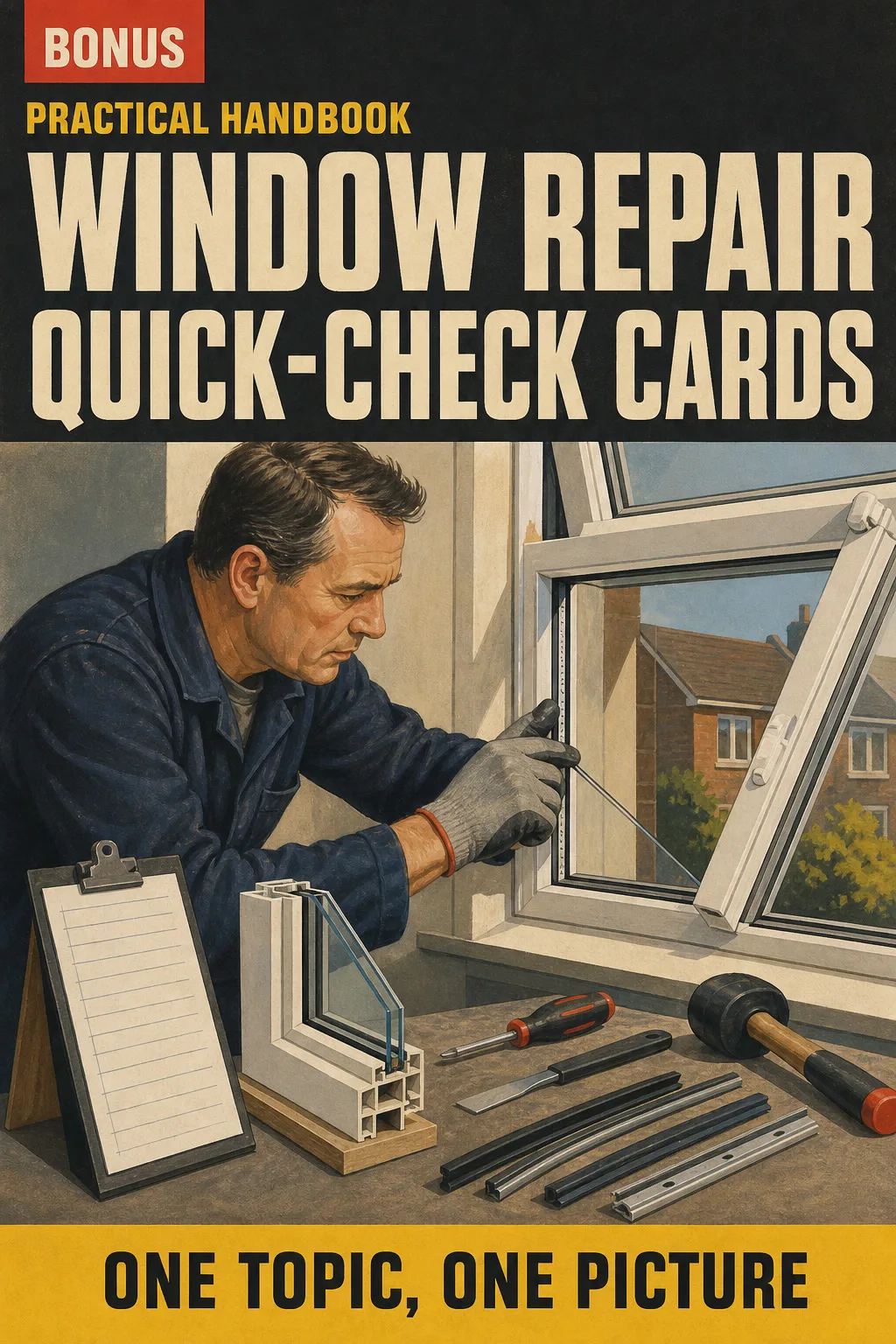
Window Repair Quick-Check Cards

BONUS 2: «Window Repair Quick-Check Cards»

Value on its own: US$ 14.90

The most common mistakes and the checks that catch them, on printable cards to keep in the van and look over before you take a bead out.

Double Glazing Repair Illustrated with 2 Free Books

  • Double Glazing Repair Illustrated: 69 illustrated pagesUS$ 63
  • BONUS 1: Measure & Order Workbook: 20 Worked WindowsUS$ 17.90
  • BONUS 2: Window Repair Quick-Check CardsUS$ 14.90
  • High-resolution PDF to printIncluded
Total value US$ 95.80
YOUR PRICE:
US$ 27
You save US$ 68.80
YES, I WANT DOUBLE GLAZING REPAIR ILLUSTRATED FOR US$ 27

📄 This is a digital PDF book sent to your email: nothing is printed or shipped.

Secure purchaseEncrypted payment30-day guarantee

PDF by email: We email you Double Glazing Repair Illustrated as a PDF, together with the two free books. It's a single payment: no installments, no extra charges.

Who This Book Is For

You're adding windows to your work

You're adding windows to your work

You've done carpentry or general repairs for years and misted units keep coming up. The book takes you through the whole job in order, so you can say yes to those calls.

You've got a unit to change this week

You've got a unit to change this week

Your windows are from the 90s or 2000s and one unit has misted. The pages show how to measure it, order just the sealed unit and fit it, and when the job needs a registered installer instead.

You already repair windows

You already repair windows

You keep it printed in the van for the jobs you do less often: timber beads, aluminium wedge gaskets, egress stays, where safety glass goes.

Everything You Get Today

US$ 95.80US$ 27
YES, I WANT DOUBLE GLAZING REPAIR ILLUSTRATED FOR US$ 27

📄 This is a digital PDF book sent to your email: nothing is printed or shipped.

30DAYS
GUARANTEE

30-Day Guarantee

Try Double Glazing Repair Illustrated for 30 days, bonus books included.

We refund everything if the file won't open, if the book isn't what you see here, if you were charged twice or if the email doesn't arrive. Just email us.

You pay once. No subscriptions.

Frequently Asked Questions

Is it for me if I've worked with my hands for years but I'm new to glazing?

Yes. It isn't academic and it doesn't talk down to you: it's the job drawn in the order you do it on site, for uPVC, timber and aluminium frames in the UK. If you already fit units, it's the reference for the jobs you do less often.

Where does the content come from?

From BS 6262 glazing practice, the product standards for sealed units, toughened and laminated glass, and the Approved Documents of the Building Regulations for England (K, F, B and L). Wales, Scotland and Northern Ireland have their own versions: the book tells you what to check for where you work.

Is it official material?

No. It's an independent illustrated guide. It doesn't reproduce the regulations or the standards: it tells you what to check against the current version.

Does it replace a course or hands-on training?

No. It's a study and reference book. It doesn't replace practical training, the manufacturer's instructions or a registered installer where one is needed, for example when the whole window is replaced.

Does it cover friction stays and handles, or just the glass?

Both. A whole part covers hardware: friction stays and how to measure them, egress stays, swapping a stay, espag handles and gearboxes, multi-point locks and dropped sashes. The workbook's 20 windows are written for this book to practise measuring and ordering.

When and how does it arrive?

The book and the 2 bonus books come as PDFs by email, to the address you enter at checkout.

Do I have to pay every month?

No. It's a one-off payment.

Can I have it on paper?

Yes. It's a printable PDF: print the pages you need, or the whole book, and keep it in the van.

How does the refund work?

You have 30 days. We refund everything if the file won't open, if the book isn't what you see on this page, if you were charged twice or if the email doesn't arrive: just email us.

Before You Close This Page

No more rereading and losing it all on site.

Setting blocks, beads and gaskets: you see them drawn and that's it.

You get to the job knowing where everything goes.

Drawings make studying faster.

The book is right below.

One-time payment: US$ 27 · Guarantee: 30 days · PDF by email

YES, I WANT DOUBLE GLAZING REPAIR ILLUSTRATED FOR US$ 27

📄 This is a digital PDF book sent to your email: nothing is printed or shipped.